
Technology Helps Doctors Diagnose Lung Cancer Earlier; Hospital is First in Sumner County to Offer Robotic-Assisted Lung Biopsy Technology
December 22, 2025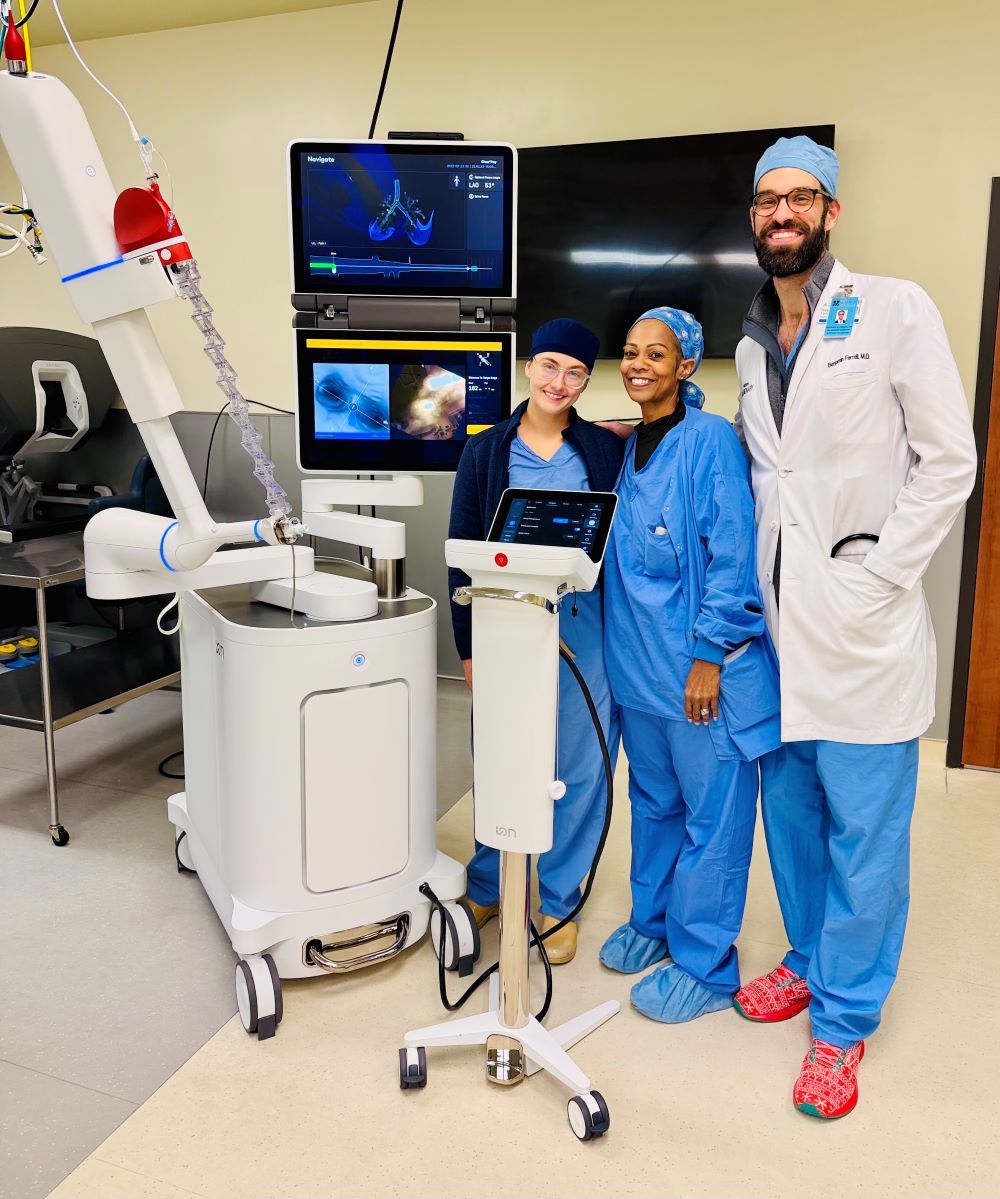
Highpoint Health – Sumner with Ascension Saint Thomas is transforming lung cancer diagnosis in a community setting with the recent addition of the ION robotic-assisted platform. Lung cancer – the leading cause of cancer death in the United States – is often referred to as a silent killer because patients often remain asymptomatic until the cancer progresses to an advanced state and is less treatable. The hospital’s lung nodule program is working to reverse that statistic for patients in Sumner County with the addition of its new ION robotic navigational bronchoscopy technology.
The ION technology is a minimally invasive and more precise way for physicians to diagnose and stage lung cancer in one setting. The artificial intelligence (AI) system creates a 3D map of the patient’s lungs using a CT scan. The software then generates the safest and most efficient route through the lung to the nodule - a small abnormal lesion or spot - or mass. Once the route is determined, an ultrathin and ultra-maneuverable catheter is guided to the lung nodule or mass site, where it is marked and biopsied with precision and stability. The samples are then evaluated on-site.
The first ION procedures in Sumner County were performed last week by Dr. Benjamin Ferrell, an experienced pulmonologist at Highpoint Health -Sumner.
“It’s very exciting to bring this type of technology once thought of as only available in the big cities to Sumner County. We are at a forefront of standing up a comprehensive lung cancer program in Gallatin to serve patients closer to home, “ Dr. Ferrell said. “This technology greatly enhances our ability to identify even the smallest lesions in the furthest reaches of the lungs. We are going to improve patient’s outcomes greatly by catching lung cancer earlier, while it is more treatable.”
“The ION technology is a great addition to Highpoint Health’s Lung Nodule Program, which already offers low-dose CT lung screenings for proactive identification and treatment of at-risk patients and screens patients for incidental findings,” said Rod Harkleroad, CEO of Highpoint Health – Sumner and market president of the system.
The hospital’s incidental lung program is set up to alert a team of specialists if a lung nodule has been detected incidentally during a scan ordered by a physician or other specialist looking for something else. For example, if a patient comes to the ER and gets a CT scan of the heart, the hospital’s AI technology can identify if a lung nodule is present. Once nodules are identified, a patient navigator will contact the patient to offer personalized follow-up care with a multidisciplinary team.
“Only 6 percent of eligible patients ever get a lung cancer screening. Many patients who develop lung cancer never know they have it until the cancer has progressed. The bulk of lung cancer nodules are found through incidental findings,” Harkleroad said. “That’s why our prevention and detection programs combined with this new technology are so important for a community like ours.”